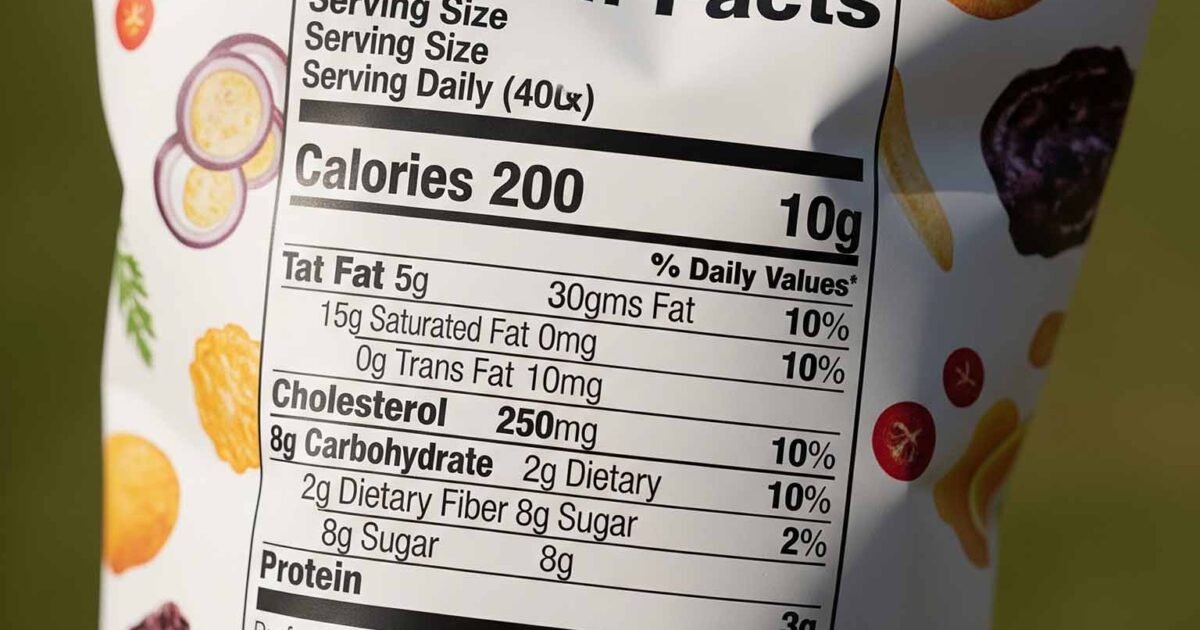
Nutrition labels are one of the most useful tools available for understanding what is inside packaged foods and beverages. They can tell you how many calories a food provides, how much fat, carbohydrate, protein, fiber, sodium, sugar, vitamins, and minerals it contains, and how much a serving contributes to your daily nutritional needs.
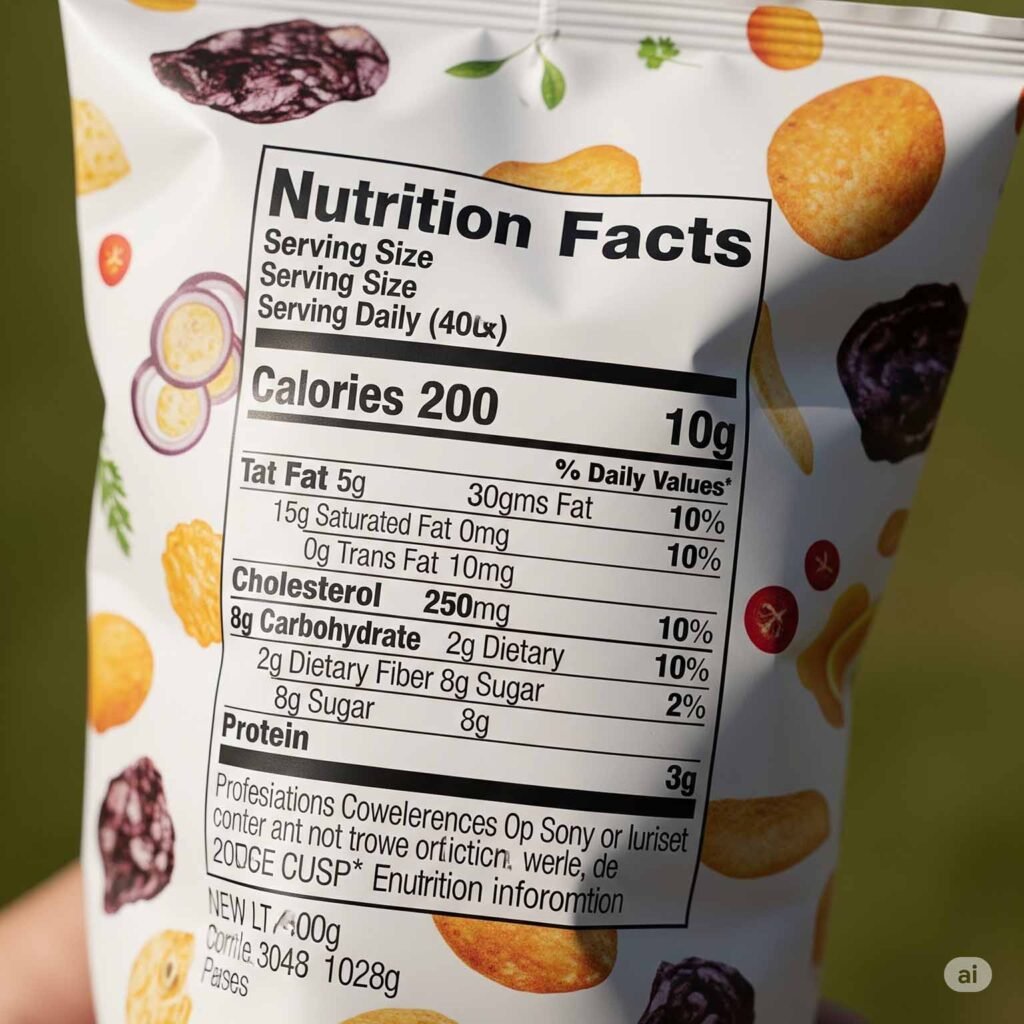
However, food labels can also be confusing. Terms such as serving size, calories, % Daily Value, total sugars, added sugars, saturated fat, and ingredients can make it difficult to know what information matters most.
Learning how to read nutrition labels correctly can help you compare products, identify nutrient-dense foods, control portion sizes, reduce excessive intake of sodium and added sugars, and choose foods that better fit your individual nutritional needs.
Table of Contents
This guide explains how to read a food nutrition label step by step, what the major sections mean, how to interpret serving sizes and calories, how to use percent Daily Value, how to evaluate carbohydrates and fats, how to understand sugar and sodium information, and how to use the ingredients list alongside the Nutrition Facts panel.
What Is a Nutrition Label?
A nutrition label is information provided on packaged food or beverage products that describes their nutritional composition.
Depending on the country and labeling regulations, the exact appearance and required information can differ. In the United States, the standardized Nutrition Facts label provides information about serving size, calories, macronutrients, certain vitamins and minerals, and other nutrients.
The label is designed to help consumers make informed food choices and compare different products.
Although this article uses terminology found on the U.S. Nutrition Facts label, the basic principles are useful when reading food labels in many countries.
Why Is Reading Nutrition Labels Important?
Two foods may look similar on a supermarket shelf but have very different nutritional profiles.
For example, two breakfast cereals may have similar serving sizes but differ substantially in:
- Calories
- Dietary fiber
- Added sugars
- Sodium
- Protein
- Vitamins and minerals
Similarly, two types of bread may both be marketed as healthy while having different amounts of whole grains, fiber, sodium, and added sugars.
Reading the label allows you to look beyond marketing claims on the front of the package and examine the actual nutritional information.
The Main Parts of a Nutrition Label
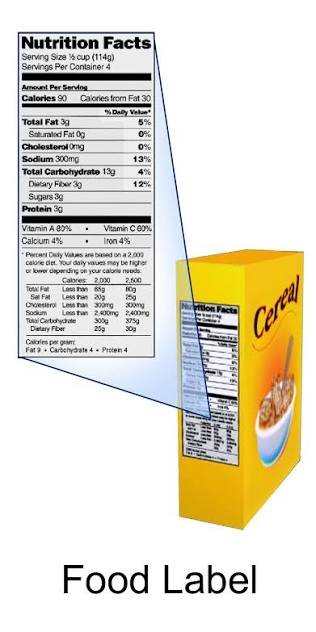
A typical Nutrition Facts label contains several important sections:
- Serving size
- Servings per container
- Calories
- Total fat
- Saturated fat
- Trans fat
- Cholesterol
- Sodium
- Total carbohydrate
- Dietary fiber
- Total sugars
- Added sugars
- Protein
- Vitamins and minerals
- Percent Daily Value (%DV)
The ingredient list is usually located separately from the Nutrition Facts panel, but it is equally important when evaluating the overall quality of a packaged food.
Step 1: Check the Serving Size
Serving size should be the first thing you look at on a nutrition label.
The serving size tells you how much food the nutritional information refers to. It may be expressed using a household measurement such as a cup, tablespoon, slice, piece, or another familiar unit, along with a metric weight or volume.
For example, a package might list:
- Serving size: 1 cup (30 g)
- Servings per container: 4
This means the calorie and nutrient information shown on the label applies to one cup or 30 grams of the product.
It does not necessarily mean that one cup is the amount you personally should eat.
The FDA specifically notes that a serving size is not a recommendation of how much food a person should consume. It is intended to reflect the amount people typically consume.
Why Serving Size Matters
Suppose a snack contains 200 calories per serving, but you eat two servings.
Your actual calorie intake would be:
200 calories × 2 servings = 400 calories
The same calculation applies to nutrients.
If one serving contains 10 grams of sugar and you eat three servings, you consume:
10 g × 3 = 30 g of sugar
This is one of the most common mistakes people make when reading food labels: they see the numbers but forget to multiply them by the number of servings they actually consume.
Servings Per Container
The label should also tell you how many servings are contained in the package.
A package may look like a single portion but actually contain two, three, four, or more servings.
For example, a bottle of a beverage may contain two servings even though a person might drink the entire bottle at once.
If the label provides 100 calories per serving and the bottle contains two servings, drinking the entire bottle provides 200 calories.
Always ask:
“How much of this package am I actually going to eat or drink?”
Step 2: Look at the Calories
Calories indicate the amount of energy provided by a serving of food or drink.
Calories can come from carbohydrates, fats, proteins, and alcohol.
For example:
- Carbohydrate provides approximately 4 calories per gram.
- Protein provides approximately 4 calories per gram.
- Fat provides approximately 9 calories per gram.
- Alcohol provides approximately 7 calories per gram.
The calorie number on the label refers to the specified serving size.
Therefore, if the serving size is 30 grams but you eat 60 grams, you have eaten two servings and approximately twice the listed calories.
Are Calories Always Bad?
No.
Calories are not inherently unhealthy. Your body requires energy to maintain essential functions such as breathing, circulation, temperature regulation, movement, brain activity, and cellular processes.
The important issue is whether your overall energy intake is appropriate for your individual needs.
A food containing more calories is not automatically unhealthy, just as a low-calorie food is not automatically nutritious.
For example, nuts and seeds can be relatively calorie-dense but provide protein, unsaturated fats, fiber, vitamins, minerals, and other beneficial compounds.
Step 3: Understand Percent Daily Value (%DV)
The % Daily Value tells you how much a nutrient in one serving contributes to the daily reference amount for that nutrient.
The FDA uses the following general rule when interpreting %DV:
- 5% DV or less: considered low.
- 20% DV or more: considered high.
This can make labels easier to interpret without requiring you to memorize the recommended intake for every nutrient.
For example, if a food contains 25% DV of calcium per serving, that serving provides a relatively high contribution to the Daily Value for calcium.
High and Low %DV: What Should You Look For?
For nutrients you generally want more of, such as dietary fiber, calcium, iron, potassium, and vitamin D, a higher %DV can be useful.
For nutrients that many people are advised to limit, such as sodium, saturated fat, and added sugars, a lower %DV may be preferable.
The FDA identifies 5% DV or less as low and 20% DV or more as high as a general guide.
Step 4: Understand Total Fat
Total fat tells you how many grams of fat are contained in one serving.
Fat is an essential nutrient. It provides energy, contributes to cell membranes, supports absorption of fat-soluble vitamins, and plays important roles in the body.
However, the type of fat matters.
The Nutrition Facts label separates total fat into categories including:
- Saturated fat
- Trans fat
Some labels and products may also provide additional information about monounsaturated and polyunsaturated fats, although these are not always required.
Understanding Saturated Fat
Saturated fat is a type of fat found naturally in foods such as fatty meats, butter, cheese, cream, and some tropical oils.
Many dietary guidelines recommend limiting saturated fat and replacing some sources with unsaturated fats.
When comparing similar packaged foods, checking saturated fat can help you identify products that contain less of this type of fat.
Understanding Trans Fat
Trans fat is another type of dietary fat associated with adverse cardiovascular health effects.
Artificial industrial trans fats have been substantially reduced or eliminated from many food supplies through regulatory changes, although labeling and food regulations differ by country.
When reading a label, check the trans fat line and also examine the ingredients list for terms associated with partially hydrogenated oils where relevant.
Step 5: Check Sodium
Sodium is an essential mineral and electrolyte, but excessive sodium intake can contribute to increased blood pressure in many people.
Processed and packaged foods can be significant sources of sodium.
Foods that may contain substantial amounts include:
- Processed meats
- Instant noodles
- Packaged soups
- Sauces
- Salty snacks
- Processed cheeses
- Some canned foods
- Prepared frozen meals
When comparing similar products, choosing the option with less sodium can be useful, especially for people who have been advised to limit sodium.
How to Interpret Sodium %DV
The FDA Daily Value for sodium is currently 2,300 mg per day.
A product containing 460 mg of sodium per serving would provide approximately 20% of the Daily Value.
If you eat two servings, you would consume approximately 920 mg of sodium, or about 40% of the Daily Value.
This illustrates why serving size and %DV need to be considered together.
Step 6: Understand Total Carbohydrates
Total carbohydrate includes several components, including dietary fiber and sugars.
On a standard Nutrition Facts label, total carbohydrate may be broken down into:
- Dietary fiber
- Total sugars
- Added sugars
Carbohydrates are an important source of energy, and carbohydrate-containing foods can also provide fiber, vitamins, minerals, and other nutrients.
The quality of carbohydrate-containing foods matters, not simply the number of grams of carbohydrate.
Step 7: Check Dietary Fiber
Dietary fiber is a type of carbohydrate that is not fully digested and absorbed in the small intestine.
Fiber can support digestive health and is associated with several health benefits.
Good dietary sources include:
- Beans
- Lentils
- Whole grains
- Vegetables
- Fruits
- Nuts
- Seeds
When comparing packaged foods, a higher fiber content can be beneficial, particularly when the product also has a nutritious ingredient profile.
The current FDA Daily Value for dietary fiber is 28 grams per day based on a 2,000-calorie reference diet.
Step 8: Understand Total Sugars
Total sugars include both naturally occurring sugars and added sugars.
Naturally occurring sugars can be found in foods such as:
- Fruits
- Milk
- Some vegetables
Added sugars are sugars incorporated into foods during processing or preparation.
Therefore, two foods containing the same amount of total sugar can have very different nutritional profiles.
For example, plain milk naturally contains lactose, while a sweetened dessert may contain substantial added sugar.
Step 9: Understand Added Sugars
Added sugars are sugars added during processing, preparation, or packaging. They can include ingredients such as sucrose, dextrose, syrups, honey, and sugars from concentrated fruit or vegetable juices under the FDA definition.
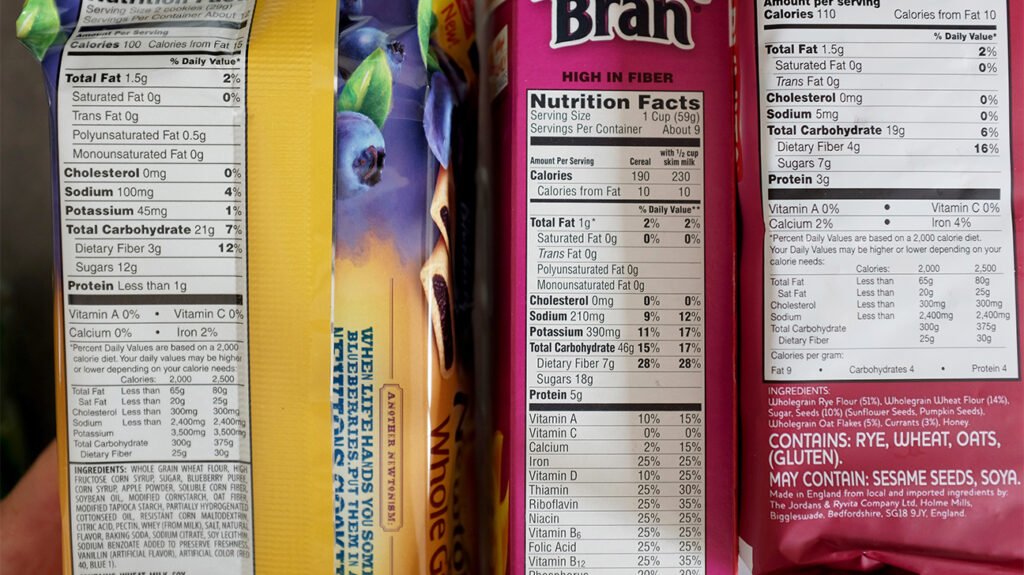
The Nutrition Facts label separately identifies added sugars beneath total sugars.
This distinction is important because a food can contain natural sugar without being high in added sugar.
For example, plain yogurt may contain naturally occurring lactose. A flavored yogurt may contain both naturally occurring sugar and added sugar.
How Much Added Sugar Is Too Much?
The FDA Daily Value for added sugars is 50 grams per day based on a 2,000-calorie diet.
The Dietary Guidelines for Americans recommend limiting calories from added sugars to less than 10% of total daily calories.
When comparing similar packaged foods, choosing products with less added sugar can be useful.
The %DV provides a convenient way to identify products that are relatively low or high in added sugars:
- 5% DV or less: low in added sugar.
- 20% DV or more: high in added sugar.
Step 10: Look at Protein
Protein is essential for maintaining and repairing tissues, supporting immune function, producing enzymes and hormones, and performing many other biological functions.
Protein content can be particularly useful when comparing foods such as:
- Yogurt
- Milk
- Breakfast cereals
- Protein bars
- Plant-based foods
- Frozen meals
However, a product being marketed as “high protein” does not automatically mean it is nutritionally superior. Check the entire label, including calories, saturated fat, sodium, added sugars, and fiber.
Step 11: Check Vitamins and Minerals
Nutrition labels can also provide information about important micronutrients.
On the U.S. Nutrition Facts label, required vitamins and minerals include vitamin D, calcium, iron, and potassium, while other nutrients may be listed voluntarily or under specific circumstances.
These nutrients perform different functions.
- Vitamin D: important for calcium metabolism, bone health, and other physiological functions.
- Calcium: important for bones, teeth, muscle contraction, and nerve function.
- Iron: required for hemoglobin and oxygen transport.
- Potassium: important for fluid balance, nerve function, and muscle contraction.
When comparing foods, products providing useful amounts of essential micronutrients can contribute to overall diet quality.
Step 12: Read the Ingredients List
The Nutrition Facts panel tells you about nutrient quantities, while the ingredients list tells you what the food is made from.
These two sections should be used together.
Ingredients are generally listed in descending order by weight, meaning ingredients present in larger quantities generally appear earlier in the list.
If a food’s ingredient list begins with whole grains, vegetables, legumes, nuts, or other nutrient-dense ingredients, that can provide useful information about the product.
If the first several ingredients are refined starches, sugars, or other ingredients you are trying to limit, you may want to compare the product with alternatives.
Why the Ingredients List Matters
Consider two breakfast cereals that have similar calorie counts.
Cereal A might contain whole grains as its primary ingredients and provide substantial dietary fiber.
Cereal B might contain refined grains and several forms of added sugar while providing very little fiber.
The calorie number alone would not tell you this difference.
Looking at both the Nutrition Facts panel and the ingredient list gives you a more complete picture.
Different Names for Added Sugar
Added sugars can appear under many different names.
Examples include:
- Sucrose
- Glucose
- Dextrose
- Fructose
- Corn syrup
- High-fructose corn syrup
- Brown sugar
- Invert sugar
- Molasses
- Honey
- Maple syrup
- Agave nectar
However, recognizing different sugar names should not turn label reading into a search for a single “bad” ingredient. The total nutritional profile and the role of the food within your overall diet are more important.
Understanding Food Marketing Claims
Food packages often use terms designed to attract consumers.
Examples include:
- Low fat
- Fat free
- No added sugar
- Reduced sodium
- High protein
- Whole grain
- Natural
- Light
- Organic
- Gluten free
- Heart healthy
These claims can provide useful information, but they should not replace reading the Nutrition Facts panel and ingredients list.
A product can make one favorable nutritional claim while still being high in another nutrient you are trying to limit.
“Low Fat” Does Not Automatically Mean Healthy
A low-fat product may contain less fat than a conventional version, but this does not necessarily mean it is the best choice.
Some low-fat foods can contain significant amounts of added sugars, sodium, or refined carbohydrates.
Instead of focusing on one marketing statement, compare the full nutrition profile.
“No Added Sugar” Does Not Mean Sugar-Free
A product labeled “no added sugar” may still contain naturally occurring sugars.
For example, a dairy product can contain naturally occurring lactose, while fruit-based products can contain naturally occurring sugars.
Always check the total sugars and ingredients list rather than assuming that “no added sugar” means the product contains no sugar.
“Natural” Does Not Tell You Everything
The word “natural” on a package does not provide a complete picture of the nutritional quality of the product.
A food can be described using appealing marketing language while still containing considerable sodium, added sugars, saturated fat, or calories.
Use the nutrition panel and ingredient list to evaluate the product itself.
“Whole Grain” Does Not Always Mean 100% Whole Grain
Products can contain whole grains while also containing refined grains or other ingredients.
If you are specifically looking for a predominantly whole-grain product, examine the ingredient list carefully.
Ingredients such as whole wheat flour, whole-grain oats, whole-grain maize, or other clearly identified whole grains can provide useful clues about the composition of the product.
How to Compare Two Similar Foods
When comparing two products, use a consistent process.
1. Compare Serving Sizes
Make sure you are comparing similar quantities. Comparing a label based on 30 grams with another based on 100 grams can produce misleading conclusions.
2. Compare Calories
Look at how much energy each product provides for the amount you actually intend to eat.
3. Compare Saturated Fat
If choosing between similar foods, the product with less saturated fat may be preferable depending on your dietary goals.
4. Compare Sodium
Look for the product that provides less sodium when sodium reduction is a priority.
5. Compare Fiber
A higher-fiber option may provide greater nutritional value and support digestive health.
6. Compare Added Sugars
Check both grams and %DV rather than relying on front-of-package claims.
7. Compare Protein
Protein can be useful when evaluating foods where protein intake is an important consideration.
8. Read the Ingredients
Finally, examine the ingredients list to understand what the product is actually made from.
A Simple Example of Comparing Food Labels
Imagine you are comparing two breakfast cereals.
| Nutrient | Cereal A | Cereal B |
|---|---|---|
| Calories | 150 | 160 |
| Total carbohydrate | 30 g | 34 g |
| Dietary fiber | 5 g | 2 g |
| Total sugars | 8 g | 14 g |
| Added sugars | 3 g | 11 g |
| Protein | 5 g | 3 g |
| Sodium | 120 mg | 250 mg |
Cereal B has only slightly more calories, but Cereal A provides more fiber and protein while containing less added sugar and sodium.
This demonstrates why calories alone are not enough to judge a food.
Nutrition Labels and Weight Management
Nutrition labels can be useful for people trying to manage their body weight because they provide information about calorie density and portion sizes.
However, calorie counting is not the only approach to healthy eating.
Foods rich in vegetables, fruits, whole grains, legumes, nuts, seeds, and other minimally processed ingredients can provide substantial nutrition and satiety.
The most appropriate approach depends on an individual’s goals, preferences, health status, and overall dietary pattern.
Nutrition Labels for People With Diabetes
People with diabetes may find nutrition labels especially useful for evaluating total carbohydrate, dietary fiber, total sugars, added sugars, and serving sizes.
The amount of carbohydrate consumed can affect blood glucose levels, while fiber can influence how carbohydrates are digested and absorbed.
However, carbohydrate needs and medication considerations vary among individuals. People with diabetes should work with their healthcare team when developing an individualized eating plan.
Nutrition Labels and High Blood Pressure
For people who need to reduce sodium intake, the sodium line on the Nutrition Facts label is particularly important.
Packaged foods can contribute substantial amounts of sodium, even when they do not taste extremely salty.
Comparing similar products based on sodium per serving and considering the number of servings consumed can help reduce total sodium intake.
Nutrition Labels for Children
Nutrition labels can also help parents and caregivers make informed choices for children.
However, children have different energy and nutrient requirements depending on age, growth, activity level, and development.
Instead of focusing only on calories, parents can consider overall nutritional quality, including protein, fiber, fruits, vegetables, whole grains, and essential vitamins and minerals.
Nutrition Labels and Allergies
People with food allergies should pay close attention to ingredient lists and allergen statements.
A nutrition label primarily describes nutrient content; it is not a substitute for checking allergen information.
Individuals with diagnosed food allergies should follow the advice of their healthcare professionals and applicable food-labeling guidance.
Nutrition Labels and Special Diets
People following specific dietary patterns may focus on different parts of a label.
For example:
- Low-sodium diets: sodium content may be particularly important.
- High-fiber diets: dietary fiber can be a major consideration.
- Weight-management diets: calories, serving size, protein, fiber, and overall food quality may be relevant.
- Diabetes-friendly eating patterns: total carbohydrate, fiber, sugars, and added sugars may be important.
- Heart-healthy diets: saturated fat, sodium, fiber, and overall food quality can be considered.
- Food allergy diets: ingredients and allergen information are essential.
How to Read a Nutrition Label in 30 Seconds
You do not need to spend several minutes analyzing every package.
A quick approach is:
- Check the serving size.
- Ask how many servings you will actually eat.
- Look at calories.
- Check saturated fat and sodium.
- Check dietary fiber.
- Check total and added sugars.
- Look at protein.
- Scan important vitamins and minerals.
- Read the ingredients if the choice is close.
This simple process can make grocery shopping much easier.
Common Mistakes When Reading Nutrition Labels
Mistake 1: Ignoring Serving Size
A person may see 150 calories on a package and assume the entire package contains 150 calories when it actually contains three servings.
Mistake 2: Looking Only at Calories
Calories are important, but they do not tell you everything about nutritional quality.
Mistake 3: Confusing Total Sugar With Added Sugar
Total sugars include both naturally occurring and added sugars, while added sugars identify sugars introduced during processing or preparation.
Mistake 4: Ignoring Sodium
Some foods can contain substantial sodium without tasting extremely salty.
Mistake 5: Ignoring Fiber
Two products with similar carbohydrate content may differ greatly in dietary fiber.
Mistake 6: Trusting Front-of-Package Claims
Marketing statements can highlight one desirable characteristic without showing the complete nutritional picture.
Mistake 7: Assuming More Protein Automatically Means Healthier
A high-protein food may also contain large amounts of saturated fat, sodium, added sugars, or calories.
Mistake 8: Forgetting the Ingredients List
The Nutrition Facts panel and ingredients list provide different information and work best when considered together.
Should You Avoid All Processed Foods?
No.
Food processing is not automatically harmful. Processing can make foods safer, extend shelf life, improve convenience, and sometimes improve nutrient availability.
Foods such as pasteurized milk, frozen vegetables, canned beans, whole-grain bread, and fortified foods are all processed to some degree.
The goal should not necessarily be to eliminate every packaged food. Instead, nutrition labels can help you choose products that fit into a balanced dietary pattern.
How to Make Better Food Choices Using Labels
Instead of searching for a single perfect food, consider the overall nutritional profile.
A useful approach is to prioritize foods that provide:
- More dietary fiber
- Adequate protein
- Useful vitamins and minerals
- Less added sugar when appropriate
- Less sodium when appropriate
- Less saturated fat when appropriate
- Reasonable calorie density for your goals
At the same time, remember that foods should be evaluated within the context of your entire diet.
Nutrition Labels Are Tools, Not Rules
Nutrition labels are valuable tools, but they should not turn eating into a constant exercise in numerical perfection.
A healthy diet can include a wide variety of foods. Some foods may be higher in calories, sodium, sugar, or fat but still have a place in an overall balanced diet.
The most important goal is to understand what you are eating and make choices that fit your nutritional needs, health goals, culture, budget, and preferences.
Frequently Asked Questions About Nutrition Labels
What is the most important thing to check on a nutrition label?
Start with the serving size. The rest of the nutrition information generally depends on that serving. After that, consider calories and the nutrients most relevant to your personal health goals, such as fiber, protein, sodium, saturated fat, and added sugars.
What does 20% Daily Value mean?
A 20% Daily Value means one serving provides 20% of the Daily Value for that nutrient. The FDA generally considers 20% DV or more to be a high amount, while 5% DV or less is considered low.
What is the difference between total sugar and added sugar?
Total sugars include naturally occurring sugars and added sugars. Added sugars are sugars introduced during processing or preparation. The Nutrition Facts label separates added sugars from total sugars.
Is a food with zero grams of fat automatically healthy?
No. A fat-free food can still contain substantial amounts of sugar, refined carbohydrates, sodium, or calories. Look at the complete nutritional profile.
Is a high-protein food automatically healthy?
No. Check the protein alongside calories, saturated fat, sodium, added sugars, fiber, and the ingredients list.
What does “per serving” mean?
“Per serving” means the nutritional information applies to the serving size stated on the label. If you eat multiple servings, you consume the corresponding multiple of the listed calories and nutrients.
How do I know whether a food is high in sodium?
Check the sodium amount and %DV per serving. As a general FDA guide, 20% DV or more is considered high. Also consider how many servings you actually consume.
How do I find out if a food contains added sugar?
Check the “Added Sugars” line on the Nutrition Facts label and review the ingredients list for added sweeteners.
Is the ingredient list more important than the Nutrition Facts label?
Neither is universally more important. The Nutrition Facts panel tells you how much of various nutrients the product contains, while the ingredients list tells you what ingredients make up the product. Both provide useful information.
What is the healthiest percentage of Daily Value?
There is no single ideal %DV for every nutrient. For nutrients you generally want more of, such as fiber, a higher %DV may be useful. For nutrients you may need to limit, such as sodium, saturated fat, and added sugars, a lower %DV is generally preferable.
Are calories more important than ingredients?
Calories and ingredients answer different questions. Calories describe energy, while ingredients show what the product contains. Both should be considered when making food choices.
Conclusion
Learning how to read nutrition labels correctly can make it easier to make informed food choices. The key is to look beyond large numbers and attractive claims on the front of a package.
Start by checking the serving size and servings per container. Then examine calories, total fat, saturated fat, sodium, total carbohydrate, dietary fiber, total sugars, added sugars, and protein. Pay attention to vitamins and minerals that are relevant to your nutritional needs.
Use the % Daily Value to quickly identify whether a nutrient is relatively low or high in a serving. As a general FDA guide, 5% DV or less is considered low, while 20% DV or more is considered high.
Finally, read the ingredients list. Nutrition labels tell you how much of various nutrients are present, while the ingredients list helps you understand what the food is made from.
The goal of reading nutrition labels is not to find a perfect food. It is to understand what you are buying and eating so that you can make choices that support your individual nutritional needs and overall health.
Sources and References
- U.S. Food and Drug Administration (FDA) – How to Understand and Use the Nutrition Facts Label
- FDA – Serving Size on the Nutrition Facts Label
- FDA – Calories on the Nutrition Facts Label
- FDA – Daily Value on the Nutrition and Supplement Facts Labels
- FDA – The Lows and Highs of Percent Daily Value on the Nutrition Facts Label
- FDA – Added Sugars on the Nutrition Facts Label
- FDA – What’s on the Nutrition Facts Label
- Dietary Guidelines for Americans